

Sustainable Industrial Packaging: Switching to Eco-Friendly Materials Without Sacrificing Strength
Comments Off on Sustainable Industrial Packaging: Switching to Eco-Friendly Materials Without Sacrificing StrengthSustainable packaging does not have to mean weaker protection or higher packaging costs. Advances in material development now give manufacturers and distributors practical options for reducing waste while still protecting heavy, valuable, and demanding industrial products.
At Cougar Packaging Solutions, we help customers evaluate packaging based on how it performs in real shipping and handling conditions. Sustainable industrial packaging can combine recyclable materials, renewable cushioning, and lightweight construction without sacrificing the strength needed for industrial applications. The right material selection can also support ESG goals while improving packaging efficiency.
What Makes Industrial Packaging More Sustainable?
Sustainable industrial packaging starts with choosing materials based on the complete packaging process. Recyclability matters, but so do material consumption, product protection, shipping weight, and how efficiently packaging moves through a facility.
We can help identify opportunities to reduce unnecessary packaging without creating new problems during handling or transportation. Depending on the application, this may include recyclable corrugated materials, renewable protective packaging, reusable options, or lighter packaging constructions.
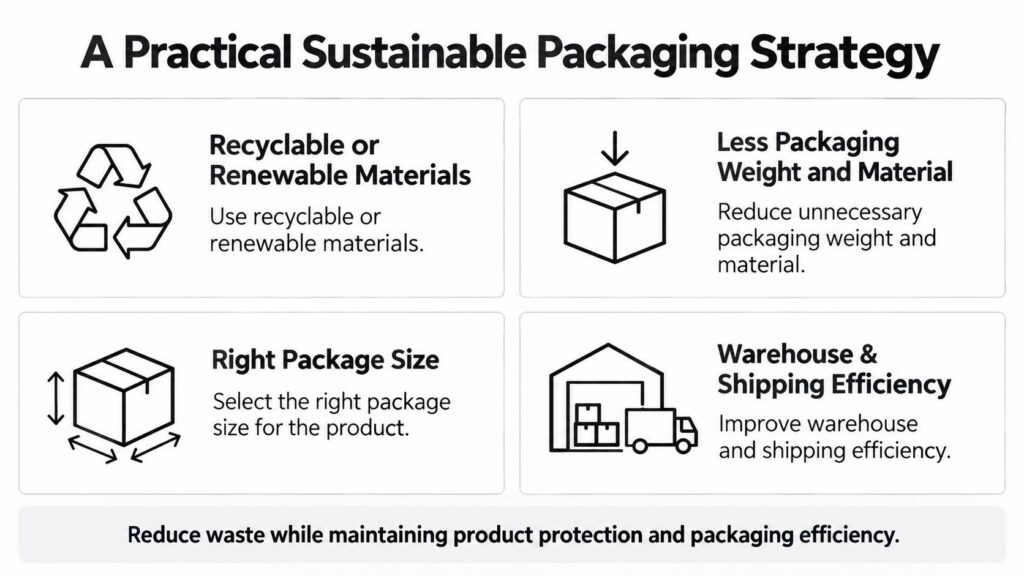
A practical sustainability strategy may include:
- Using recyclable or renewable materials
- Reducing unnecessary packaging weight and material
- Selecting the right package size for the product
- Improving warehouse and shipping efficiency
Recyclable Corrugated Board: Strength Without the Extra Waste
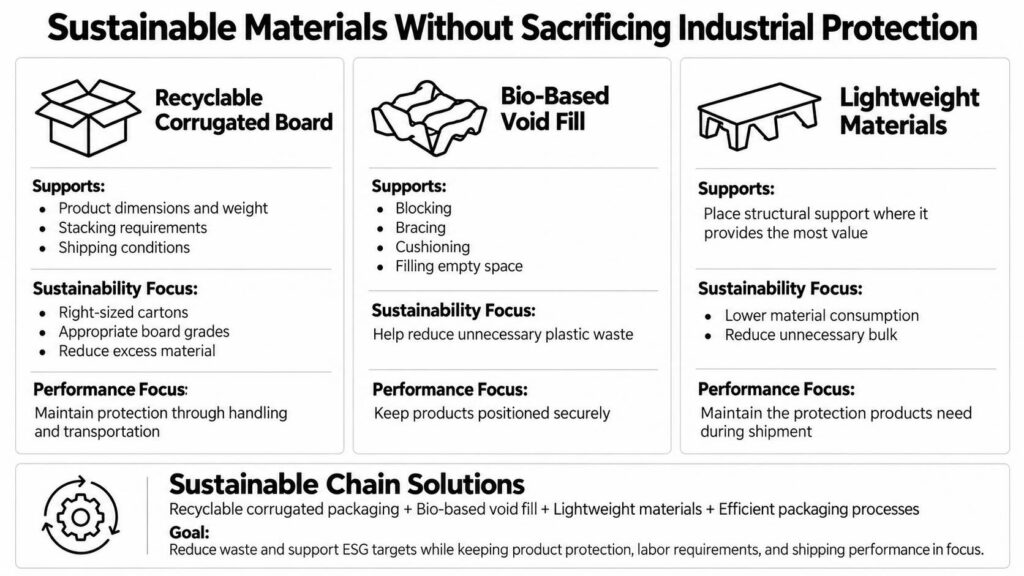
Corrugated packaging remains a strong option for industrial shipping, and modern board constructions can provide the durability needed for heavier products. Recyclable packaging can be specified according to product dimensions, weight, stacking requirements, and shipping conditions.
Rather than simply adding more material, proper package design can place strength where it is needed. Right-sized cartons and appropriate board grades can help reduce excess material while maintaining protection through handling and transportation.
Our packaging design approach considers these requirements together so you can select corrugated packaging that fits the application instead of relying on a one-size-fits-all solution.
Bio-Based Void Fill for Product Protection
Void fill plays an important role in keeping products from shifting inside a shipping container. Bio-based options, including paper cushioning, can provide a practical alternative to conventional protective materials.
For industrial shipments, the focus remains on protection. Eco-friendly shipping materials should keep products positioned securely while helping reduce unnecessary plastic waste. Paper-based void fill can be used for blocking, bracing, cushioning, and filling empty space based on the needs of the shipment.
We can help determine which protective material fits your products, packaging process, and shipping requirements.
Lightweight Materials Can Reduce More Than Packaging Waste
Reducing packaging weight can help lower material consumption while also reducing the weight moving through your warehouse and transportation network. Lightweight materials do not automatically mean reduced strength.
Modern packaging designs can use material more efficiently, placing structural support where it provides the most value. This can reduce unnecessary bulk while maintaining the protection your products need during shipment.
For customers reviewing their packaging costs, lightweight construction can provide an opportunity to address material use and operational efficiency at the same time.
Building Sustainable Chain Solutions Without Sacrificing Performance
Sustainability should extend beyond a single box or cushioning material. Sustainable chain solutions consider how packaging performs from the warehouse floor through transportation and final delivery.
Our approach can combine recyclable corrugated packaging, bio-based void fill, lightweight materials, and efficient packaging processes. The goal is to reduce waste and support ESG targets while keeping product protection, labor requirements, and shipping performance in focus.
Make the Switch Without Giving Up Strength
Sustainable packaging has moved beyond the idea that environmentally responsible materials must be weak or expensive. Today, businesses have more options for reducing material use and waste while maintaining dependable protection.
Cougar Packaging Solutions can help you evaluate Eco-friendly shipping materials, recyclable packaging, and other sustainable options based on your products and packaging operation. The right combination can support sustainability goals without giving up the strength your industrial shipments require. Contact Cougar Packaging Solutions for the right sustainable packaging for your operation.
5 Ways Custom Package Design Boosts Warehouse Packing Speed and Productivity
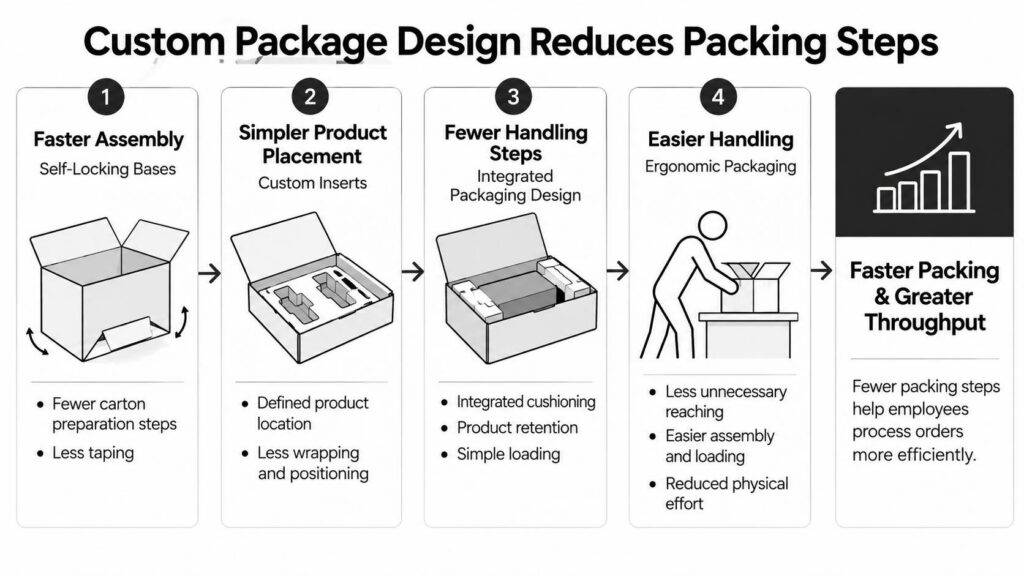
Comments Off on 5 Ways Custom Package Design Boosts Warehouse Packing Speed and ProductivityWarehouse packing speed depends heavily on how packaging is assembled, loaded, and closed. If employees have to tape cartons, add multiple layers of protective material, or repeatedly reposition products, those extra steps can slow fulfillment and increase labor demands. Custom package design can simplify these tasks by building the right features into the packaging from the start. Self-locking bases, custom inserts, and ergonomic designs can help reduce handling time while making packing easier for workers. For businesses focused on warehouse packing efficiency, the right packaging can support faster throughput without adding unnecessary work.
Self-Locking Bases Reduce Assembly and Taping Steps
Traditional cartons can require workers to fold flaps into place and apply tape before packing begins. Self-locking bases provide a faster alternative by allowing the carton to be assembled with fewer manual steps.
Reducing taping and carton preparation gives employees more time to focus on packing orders. Across a high-volume operation, even a small reduction in assembly time can add up to significant labor savings. This supports packaging labor reduction while helping employees maintain a steady packing pace.
Custom Inserts Eliminate Tedious Wrapping and Positioning
Products that need individual wrapping or loose cushioning can take longer to pack. Workers may need to cut material, wrap the product, add additional protection, and position everything inside the carton.
Custom inserts simplify that process by giving products a defined location inside the package. Instead of building protection around each item, workers can place the product into the insert and move to the next step. Our packaging solutions can incorporate inserts that support both product protection and faster packing.
This can improve fulfillment productivity by reducing repetitive wrapping and positioning work.
Packaging Designs That Require Fewer Handling Steps
Every unnecessary movement can add time to an order. Custom package design allows the carton, product, inserts, and protective materials to work together as part of one packing process.
A package can be developed around the way employees actually handle the product. Integrated cushioning, product retention, and simple loading steps can reduce repeated repositioning and extra material handling. Fewer actions mean a more consistent process and better warehouse packing efficiency.
Ergonomic Packaging Helps Reduce Worker Fatigue
Packing can involve repeated lifting, reaching, bending, and carton assembly throughout a shift. Packaging that requires awkward movements can make these tasks more tiring and slow the pace of work.
Ergonomic packaging can make cartons easier to handle, assemble, and load. Features that reduce unnecessary reaching or difficult positioning can help workers maintain a consistent pace throughout the day. By making each package easier to handle, businesses can support productivity while also contributing to packaging labor reduction.
Faster Packing Creates Greater Throughput
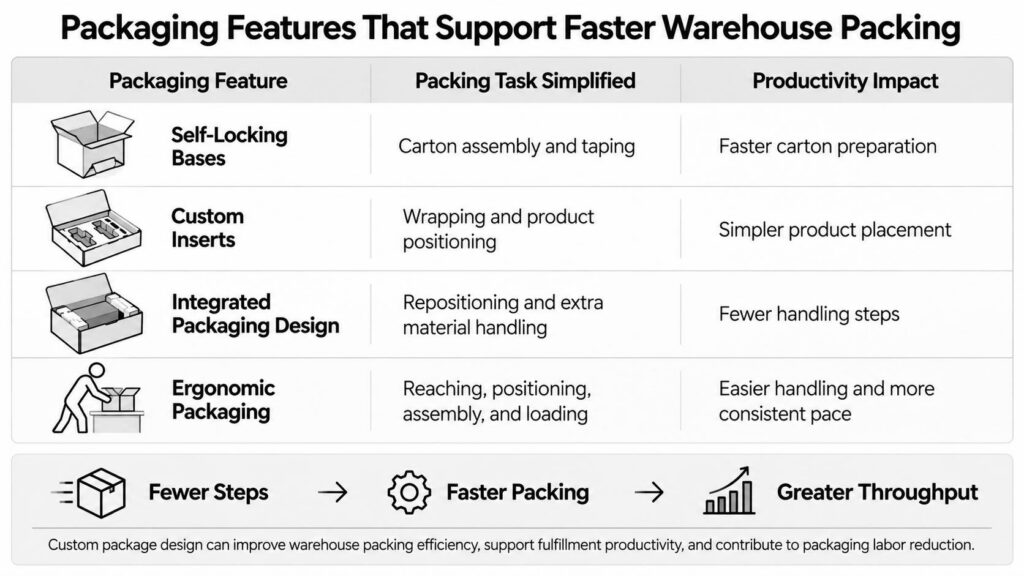
Small improvements in individual packing steps can produce meaningful results across a busy warehouse. Faster carton assembly, simpler product placement, fewer wrapping steps, and easier handling can help employees process more orders during the same shift.
The result is improved fulfillment productivity without relying solely on additional labor. Our approach to packaging considers how products move through the packing process so the packaging supports the work instead of creating more steps.
- Faster assembly: Self-locking packaging can reduce carton preparation and taping.
- Simpler packing: Custom inserts can reduce wrapping and product positioning.
- Less physical effort: Ergonomic designs can help reduce fatigue during repetitive tasks.
- Higher throughput: Fewer packing steps can help employees process orders more efficiently.
Cut the Steps. Pick Up the Pace.
Custom package design can make a measurable difference in warehouse operations. By reducing assembly, wrapping, handling, and physical effort, the right packaging can improve warehouse packing efficiency, support fulfillment productivity, and contribute to packaging labor reduction. Talk with Cougar Packaging Solutions about custom packaging that helps your team pack faster and work more efficiently.
Void Fill Breakdown: Comparing Paper, Air Pillows, Foam, and Custom Inserts for B2B Shipping
Comments Off on Void Fill Breakdown: Comparing Paper, Air Pillows, Foam, and Custom Inserts for B2B ShippingEmpty space inside a shipping carton gives products room to shift, collide, and sustain damage during handling and transportation. The right void fill packaging helps stabilize products and provides an added layer of protection without adding unnecessary material, labor, or storage demands. Paper, air pillows, foam, and custom inserts each offer different benefits for B2B shipping operations. This void fill comparison looks at cost, storage space, protection, and environmental considerations to help you select the right option for your workflow.
Paper Void Fill: A Flexible Option for Many Shipping Operations
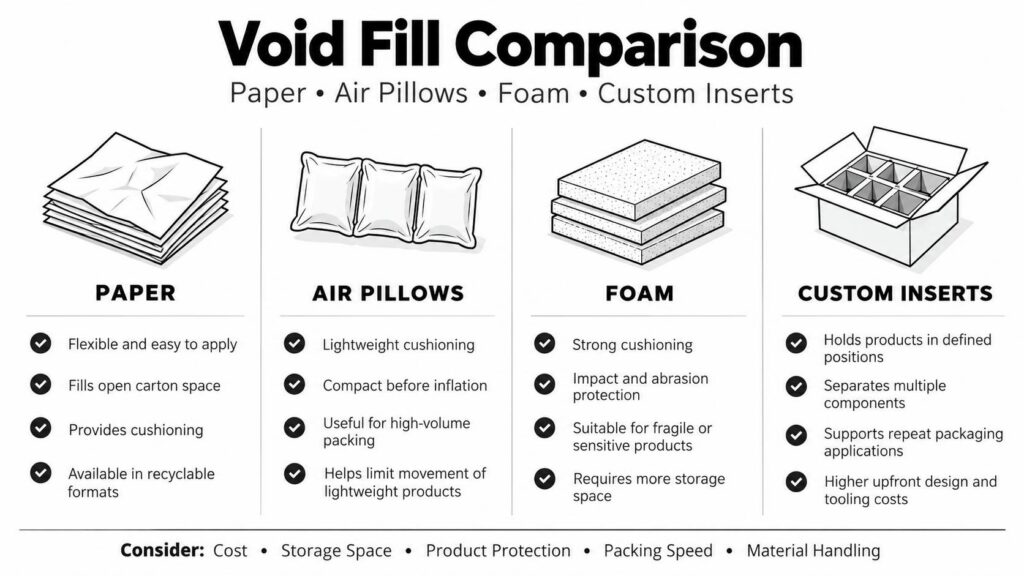
Paper void fill can be a practical choice for facilities shipping products in a range of sizes. Kraft paper and crumpled paper fill open spaces inside cartons, limit product movement, and provide cushioning around the contents.
Paper is straightforward to handle and can work well across many packing stations. It also provides a practical balance between material cost and protection. For facilities looking to reduce plastic use, recyclable paper options can support sustainability goals while still providing reliable carton fill.
Storage requirements depend on the format and volume used. Paper rolls and packs require dedicated space, but dispensing equipment can help keep packing stations organized and speed up application.
Air Pillows: Lightweight Cushioning With Efficient Storage
Air pillows provide lightweight cushioning while taking up relatively little storage space before inflation. Film rolls can be stored compactly and converted into cushioning material as orders are packed.
This can make air pillows a strong fit for high-volume operations where storage space and packing speed matter. They can fill open carton space quickly and help keep lightweight products from moving during shipment.
Air pillows may be less suitable for heavy products or items with sharp edges that could compromise the film. Plastic film also requires consideration during material selection and disposal, particularly for facilities with specific sustainability goals.
Foam Void Fill: Cushioning for Higher Protection Requirements
Foam provides cushioning for products that need more impact and abrasion protection during transportation. Foam sheets, pieces, and other formats can be used around fragile or sensitive products where basic void filling may not provide enough protection.
The tradeoff is material and storage. Pre-formed foam generally takes more warehouse space than compact film rolls or dispensing paper. However, the additional cushioning can be worthwhile for higher-value products where damage can result in costly replacements, delays, or customer complaints.
Consider the product’s weight, fragility, and shipping conditions before selecting foam as your primary protective shipping material.
Custom Packaging Inserts: Purpose-Built Product Protection
Custom packaging inserts provide a more structured approach to product protection. Inserts can hold products in specific positions, separate multiple components, and reduce movement inside the carton.
There can be higher upfront costs for design and tooling, but inserts can make sense for repeat shipments involving consistent product dimensions or higher-value items. Storage requirements also need consideration because finished inserts occupy more space than compressed or uninflated void fill materials.
Material selection matters here as well. Recyclable, reusable, and other material options can support different packaging goals while providing consistent product positioning.
Void Fill Comparison: How the Options Stack Up
There is no single best void fill packaging option for every facility. Each material brings different advantages based on the application.
- Paper: Flexible, easy to apply, and available in recyclable formats.
- Air pillows: Lightweight, compact to store, and useful for high-volume packing.
- Foam: Provides strong cushioning for fragile or sensitive products.
- Custom inserts: Hold products securely in defined positions and support repeat packaging applications.
Cost, storage space, product protection, packing speed, and material handling should all factor into your decision.
Choosing the Right Void Fill for Your Workflow
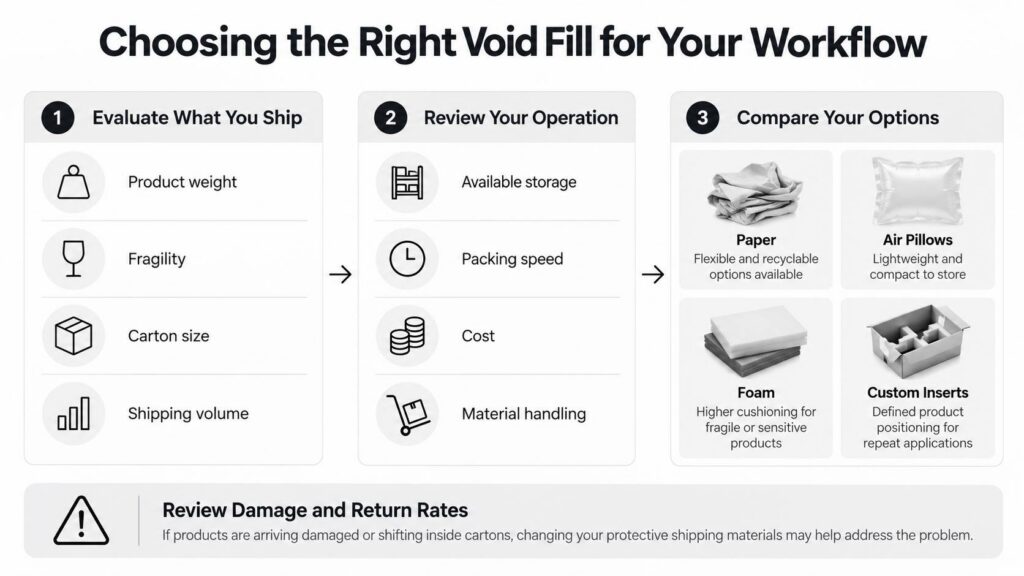
Start with the products you ship and the problems you need to solve. Product weight, fragility, carton size, shipping volume, available storage, and packing speed all affect the right material choice.
Also review damage and return rates. If products are arriving damaged or shifting inside cartons, changing your protective shipping materials may help address the problem.
At Cougar Packaging Solutions, we can help you evaluate void fill packaging and other protective shipping materials based on your specific workflow. Contact us to discuss your packaging requirements and find a practical solution for your operation.
The True Cost of Product Damage: Protecting Your Margin with Heavy-Duty Packaging Design
Comments Off on The True Cost of Product Damage: Protecting Your Margin with Heavy-Duty Packaging DesignProduct damage during shipping can affect far more than the value of the item being replaced. A damaged shipment can create return freight costs, replacement inventory expenses, added labor, reshipping charges, and lost customer confidence. These costs can quickly reduce margins, especially when damage occurs repeatedly. Cougar Packaging Solutions has heavy-duty packaging designs that helps address these risks before products leave your facility, while protective industrial packaging provides the support products need through handling, transportation, and delivery.
Calculate the Full Financial Impact of Product Damage
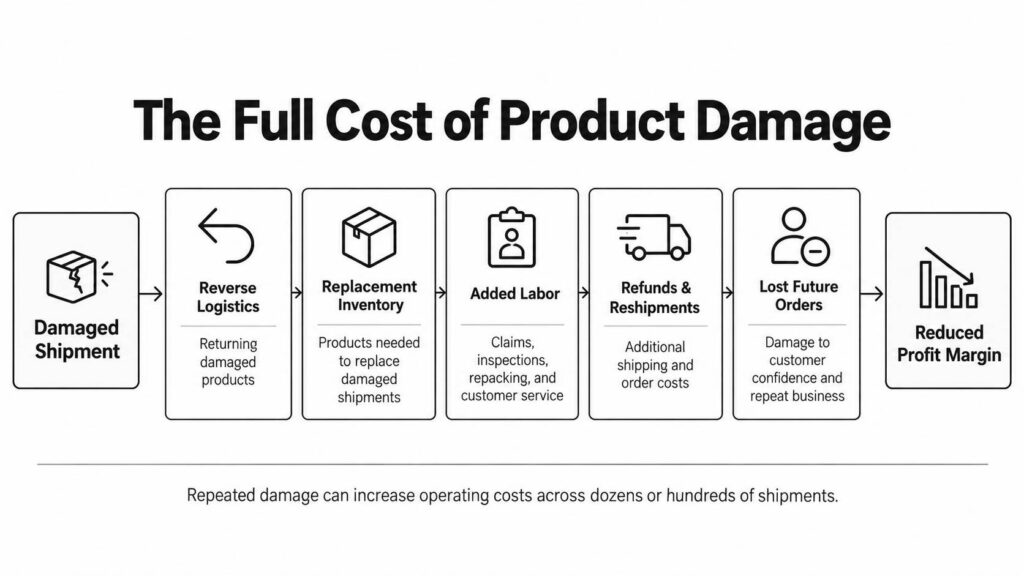
The true cost of a damaged shipment includes much more than the product itself. A single damaged order may require additional transportation, employee time, replacement inventory, and customer support.
The financial impact can include:
- Reverse logistics for returning damaged products
- Replacement inventory and additional shipping costs
- Labor for claims, inspections, repacking, and customer service
- Refunds, reshipments, and lost future orders
When these expenses occur across dozens or hundreds of shipments, the impact on your margins becomes much more significant. Tracking these costs gives you a clearer reason to invest in stronger packaging.
Why Standard Packaging May Not Be Enough for Industrial Products
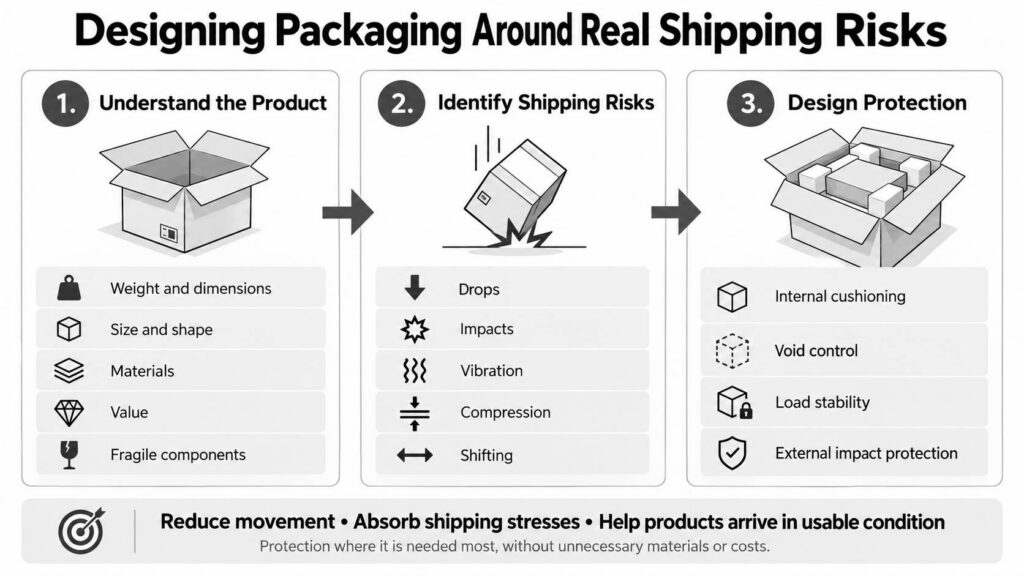
Industrial products can face demanding shipping conditions because of their weight, size, shape, materials, or value. Drops, impacts, vibration, compression, and shifting can all put products at risk.
Adding more packaging material does not always solve these problems. Our heavy-duty packaging design approach focuses on the product, how it is handled, and the conditions it is likely to face during transportation. This allows packaging to provide protection where it is needed most without adding unnecessary materials or costs.
How Protective Industrial Packaging Safeguards Products
Protective industrial packaging should account for the specific risks associated with your products. Product weight and dimensions, fragile components, internal cushioning, void control, load stability, and external impact protection can all affect packaging performance.
We can help you identify practical packaging solutions that keep products secure from packing through delivery. The goal is straightforward: reduce movement, absorb shipping stresses, and give your products the protection they need to arrive in usable condition.
Product Return Reduction Protects More Than Shipping Costs
Product return reduction can have a direct effect on your operating costs. Fewer damaged shipments mean fewer return freight charges, replacement shipments, inspections, repackaging tasks, and customer service issues.
Better packaging can also reduce disruptions to inventory. Instead of replacing products that were damaged in transit, your team can keep available inventory focused on fulfilling new orders. Our protective industrial packaging solutions can help reduce the causes of damage before they lead to a return.
Protecting Customer Trust and Long-Term Revenue
Customers expect products to arrive in the condition promised. Repeated damage can affect how they view your reliability, even when the product itself was manufactured correctly.
Reliable packaging supports a better delivery experience and can help protect repeat business. Reducing damage also gives your customer service team fewer problems to resolve, allowing them to spend more time supporting customers and less time handling preventable shipping issues.
Designing Packaging Around the Real Cost of Damage
The least expensive packaging option is not always the lowest-cost option overall. A small increase in packaging investment can make financial sense if it prevents expensive product replacements, return freight, labor, and lost orders.
We recommend looking at recurring damage patterns and identifying where packaging changes can make the biggest difference. Heavy-duty packaging design should reflect the product and its shipping requirements while supporting practical operating costs.
Protect Your Products and Your Profit Margin
Product damage affects more than individual shipments. It can increase operating expenses, disrupt inventory, create additional work, and weaken customer relationships. Product return reduction can help address these costs at their source.
At Cougar Packaging Solutions, we can help you evaluate your packaging requirements and identify protective solutions suited to your products and shipping conditions. Contact us to discuss your packaging needs and protect your products and profit margin.
